

The quarterly online update to the Court of Protection Handbook is now available, covering key practice and procedure updates to the text of the main volume. We are also working on publishing the update in hard copy as a one-off inter-edition bonus – work on the next edition cannot properly start until we have more detail about the revisions to the MCA Code of Practice and what is happening with the Liberty Protection Safeguards.
Posts
Court fees increase from 30 September 2021
Following the consultation on increasing selected court fees and Help with Fees income thresholds by inflation, the Government response to the consultation has been published and is available here.
The SI to effect these changes has been laid today, 6 September 2021, and the changes will come into effect on 30 September 2021. Any questions regarding this consultation response or the SI can be addressed to the Ministry of Justice Fees Policy Team (mojfeespolicy@justice.gov.uk).
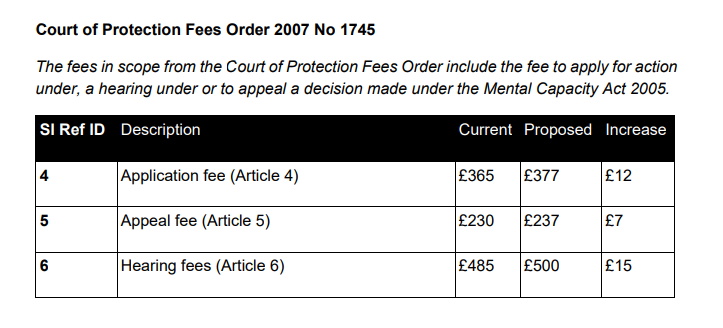
The position in respect of Court of Protection fees is as follows:

Court of Protection Handbook Quarterly Update – August 2021
A couple of days ahead of schedule, the quarterly online update to the Court of Protection Handbook is now available, covering key practice and procedure updates to the text of the main volume.
Court of Protection Handbook Quarterly Update – May 2021
The quarterly online update to the Court of Protection Handbook is now available, covering such cases as Re P (Discharge of Party) on when the court can discharge a party of its own motion, Re MN on the limited steps that the court will consider taking under s.48, and Re P (another one) on the ‘white leopard’ of the situation where a person is said to lack capacity to make a medical treatment decision but to have capacity to conduct proceedings about whether to undergo the procedure.
Court fees consultation – including Court of Protection – closing date 17 May 2021
The MoJ is consulting upon increasing court fees, including those relating to the Court of Protection, as follows:
The proposal, if implemented, would backdate increases to fees by inflation
to 2016 or (if later than 2016) the year the fee was last increased. The consultation runs until 17 May 2021, and can be found here.
CoP e-filing for deprivation of liberty cases
HMCTS have announced that:
To further support digital working within the Court of Protection we are starting to use electronic filing of documents (aka e-filing) for all Deprivation of Liberty cases. This involves the introduction of an automated system where correspondence and attachments received by email are placed directly onto the court’s digital files (e-files).
As well as providing the many general efficiencies of increased digital working, the use of the e-filing system will enable faster allocation of information to court files to ensure that judiciary and court administrators have immediate access to information within minutes of it being received by email.
When will the changes happen?
The e-filing system is being introduced at the Court of Protection to manage Deprivation of Liberty cases submitted to First Avenue House (FAH), London on/around the end of March 2021
For more details, see the update here.
Official Solicitor Practice Notes
Two Practice Notes have been published by the Official Solicitor, Sarah Castle, setting out important practicalities relating the appointment of the Official Solicitor as litigation friend of the person concerned (“P”) in the Court of Protection and requests by the court to the Official Solicitor to act as, or appoint counsel to act as an advocate to the court. Both are dated 3 February 2021. One note deals with health and welfare proceedings, and the other with property and affairs proceedings.
This serves also as a useful opportunity to remind people of the resources available on the Court of Protection Handbook website, including the following:
A basic guide to the Court of Protection written by Victoria Butler-Cole QC, Sarah Castle, Jakki Cowley and Alex Ruck Keene, which can be found here.
A glossary of words and phrases used in the Court of Protection (by the same authors), which can be found here.
A guide by Jakki Cowley called “You’re going to a welfare hearing at the Court of Protection – what does this mean for you?,” which can be found here.
An easy read guide, focusing on participation and written by Dr Jaime Lindsey of the University of Essex, which can be found here.
A guide to remote hearings has been produced by the Transparency Project. It is designed for those attending family proceedings, but has practical information which may be equally useful to those attending hearings before the Court of Protection.
Court of Protection Handbook quarterly update – February 2021
The quarterly online update to the Court of Protection Handbook is now available, covering such cases as TA on recording remote hearings, AMDC v AG & Anor on expert reports on capacity and KK on non-disclosure of material on the basis of harm to P.
The consequences of intemperate communication
In TA, Re (Recording of hearings; Communication with Court office) [2021] EWCOP 3 (22 January 2021) Cobb J was faced with a ‘troubling case” concerning GA, a woman with Alzheimer’s dementia currently being cared for at home by her son TA. “Poor progress” had been made largely because of challenges to the local authority. The judge made directions on the substantive application. These do not appear in his judgment which deals instead with two applications:
i) An application dated 17 November 2020, buttressed by a separate but similar application dated 15 January 2021, issued by TA for permission to make his own recording of this hearing and indeed all hearings in this case in the Court of Protection;
ii) An application, issued of the Court’s own motion by HHJ Anderson on 10 December 2020, for an order restricting TA’s contact with the Court of Protection Court office, given his history of communications with the court over a period of time.
Cobb J noted that the Court of Protection was not included in the list of courts in which the Coronavirus Act 2020 created an offence of making an unauthorised recording; but that the terms of the criminal prohibition are included in standard orders made since the guidance of Hayden J on remote access to the Court of Protection, so that unauthorised recordings become civil contempt of court. On the facts of this case Cobb J was far from persuaded that there was any need for TA to record hearings; moreover he considered TA was likely to publish material which would identify or run the risk of identifying GA.
The background to the second application speaks for itself:
Cobb J found that there was no justification for the tone or volume of the correspondence and quoted the judgment of King LJ in Agarwala v Agarwala
“Whilst every judge is sympathetic to the challenges faced by litigants in person, justice simply cannot be done through a torrent of informal, unfocussed emails, often sent directly to the judge and not to the other parties. Neither the judge nor the court staff can, or should, be expected to field communications of this type. In my view judges must be entitled, as part of their general case management powers, to put in place, where they feel it to be appropriate, strict directions regulating communications with the court and litigants should understand that failure to comply with such directions will mean that communications that they choose to send, notwithstanding those directions, will be neither responded to nor acted upon.”
Cobb J made use of his powers under s47 Mental Capacity Act to injunct TA from communicating with the court by email and telephone, stating that although exceptional it was proportionate to the facts of the case, and added a penal notice. The judgment concludes with the text of the order itself. Cobb did not make use of the Part 22 of the Court of Protection Rules 2017 to make a civil restraint order.
Contempt, court orders and P’s confidentiality – an update
The Court of Appeal has had little hesitation dismissing ([2020] EWCA Civ 1675) the appeal by Dahlia Griffith against her conviction and sentence of imprisonment for contempt, about which Alex has written here. Having applied out of time to appeal and for a stay of the order, which had been refused, Ms Griffith did not appear – indeed, as at the day of the hearing, she had not been found and taken into custody.
Peter Jackson LJ held as follows:
14. The first matter to consider is the Appellant’s absence at this appeal hearing. I am satisfied that she has had every opportunity to be represented and that, having chosen to represent herself, there is no good reason why she could not have attended. Her absence is unfortunately of a piece with her overall attitude to the court process. There is no good reason why her appeal should not be determined today.
15. As to that, I conclude that the Judge dealt with these committal proceedings in a way that is beyond criticism. His approach is a model of the careful and balanced assessment that is necessary in a case of this kind. His finding that the Appellant is in contempt was supported by compelling reasoning, indeed the conclusion was inevitable. His approach to the sentencing exercise cannot be faulted. A sentence of this length is a long one, but it is unfortunately necessary in circumstances where the appellant has shown no acceptance, remorse or apology for the deliberate forgery of a court order.
16. I would therefore dismiss this appeal. In doing so, I draw attention – and the Appellant’s attention in particular – to the opportunity that is given to all contemnors to seek to purge their contempt by making an application to the trial court. In circumstances of this kind, the sentence of a contemnor who accepts their contempt and makes a genuine apology for their behaviour will always be carefully reviewed.
Coulson LJ, agreeing with Peter Jackson LJ, noted that, “[A]lthough the recent changes to CPR Part 81 will do much to make the contempt procedure less cumbersome and complex, there will still be many contempt cases in which a judge will have to roll up his or her sleeves and address in detail not only the facts and the law, but all the many balancing factors necessary to achieve a just outcome.” Sadly, for these purposes, CPR Part 81 does not, in fact, apply to the Court of Protection, its contempt procedures being governed by Part 21 of the Court of Protection Rules 2017, which have yet to be updated in line with the CPR changes which took effect on 1 October 2020.
 Court of Protection Handbook